Florida is the easiest state in America to join a microschool — because the state will usually help pay for it. Between the PEP scholarship for homeschoolers and the broader Family Empowerment programs, most Florida families can fund small, teacher-led schooling with state scholarship dollars instead of out-of-pocket tuition. Here’s how the landscape works in 2026–27, what it costs, and how to pick well.
Why Florida became the microschool capital
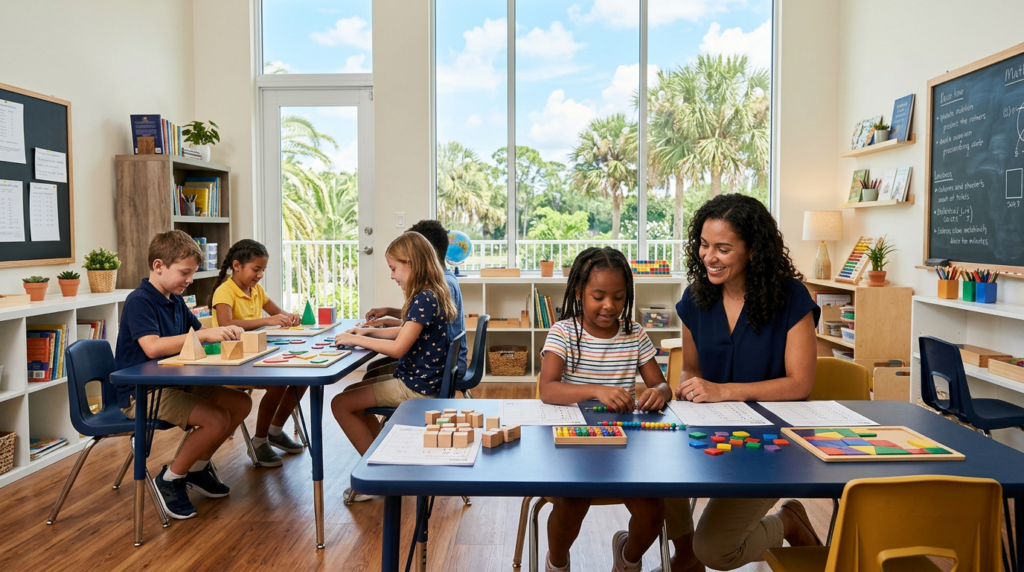
Three things converged: universal school choice (every Florida student is now scholarship-eligible), a large and organized homeschool community, and scholarship rules that let families spend funds on part-time instruction — not just full-time private school. The result is an explosion of small learning environments: full-week academies, hybrid two-day programs, and single-subject microschools that homeschooling families plug into their week.
What do Florida microschools cost?
Full-time microschools in Florida commonly charge between $6,000 and $12,000 a year. Part-time and single-subject programs are dramatically cheaper — typically $150–$400 per month — because you’re buying focused instruction, not full-day care. Our math-only program in Lakeland, for instance, is a flat $270 per month with a small one-time enrollment fee and no annual contract.
How the PEP scholarship pays for microschool classes
Florida’s Personalized Education Program (PEP) gives homeschooling families roughly $8,000 per student per year to spend on approved education expenses — including tutoring, curriculum, and part-time instruction. The smoothest setup is a direct-pay provider: the provider bills Step Up For Students directly, so you never front the money or chase reimbursements.
- Apply for PEP through Step Up For Students (watch the annual confirmation deadlines).
- Choose a provider — confirm they’re approved for direct pay.
- Enroll; tuition is billed to your student’s scholarship account each month.
Not sure what else your PEP funds can buy? Our 2026–27 PEP purchasing guide covers the current handbook rules, deadlines, and an item-by-item eligibility checker.
How to choose a Florida microschool: 7 questions to ask
- Who actually teaches — and what are their credentials? A consistent, certified teacher is the whole point of the model.
- How big are the groups? Past ~15 students, you’ve bought a small classroom, not a microschool.
- Is instruction personalized or one-pace-fits-all? Ask how they handle a student who’s behind — or way ahead.
- Full-time or subject-specific? If you love homeschooling but dread one subject, a single-subject microschool keeps you in the driver’s seat.
- Do they take PEP / Step Up direct pay? Direct pay means $0 out of pocket for most families.
- What does progress reporting look like? You should hear specifics about your child, not a newsletter.
- Can high-school work earn transcript credit? Courses like Algebra 1 should be complete, credit-worthy courses — not enrichment.
Microschool options around Polk County
If you’re in Central Florida, you don’t need to drive to Tampa or Orlando for small-group learning. Math Mavericks runs an in-person, math-only microschool program in north Lakeland serving homeschool families across Lakeland, Winter Haven, Auburndale, and Bartow — small weekly classes from K–8 through Algebra 1, taught by a Florida-certified teacher, with PEP direct pay.
Frequently asked questions
Do Florida microschools have to be accredited?
No. Accreditation is optional in Florida, and homeschool students using part-time programs don’t need it. What matters more in practice: the teacher’s credentials, group size, and whether coursework is documented well enough for your homeschool portfolio and transcript.
Can I use PEP for a full-time microschool?
PEP is designed for home education students, so it pairs best with part-time and subject-specific programs. Families wanting full-time private schooling typically use the FES-EO/FTC scholarship track instead. The rules differ — check the current Step Up handbooks before committing.
What’s a “hybrid homeschool” program?
A schedule where students attend structured classes some days and homeschool the rest of the week. Most Florida microschools — including single-subject ones like ours — fit this hybrid pattern: weekly in-person classes plus at-home practice between sessions.
When should I enroll?
Small schools fill in spring and summer for fall starts, and PEP has hard confirmation deadlines (June 15 for renewals, July 15 for new families in 2026). If you’re eyeing a program for this school year, apply early.
New to microschooling? Start with our guide to what a microschool actually is, or talk to us about whether a math microschool fits your family’s year.