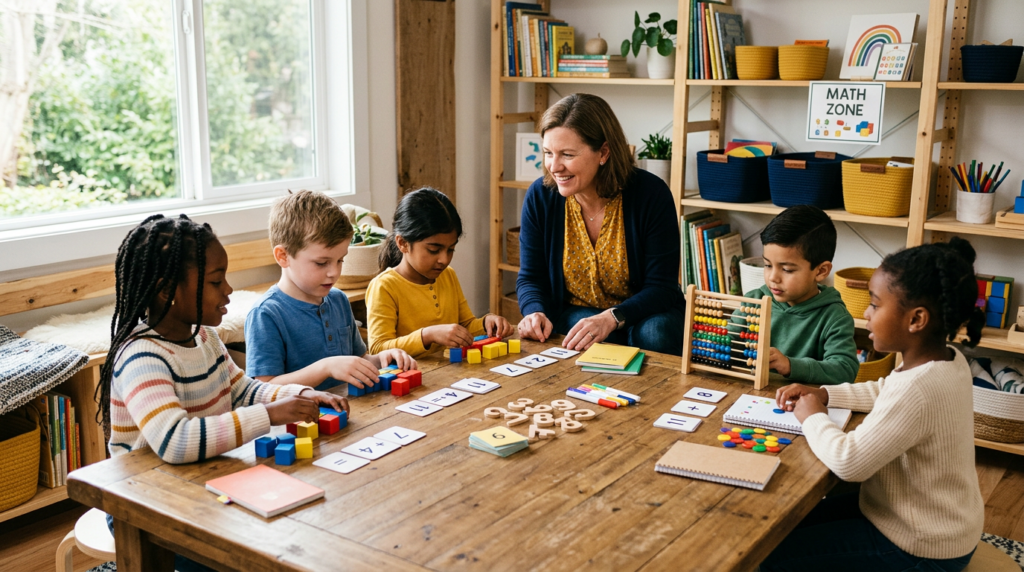
A microschool is a small, teacher-led school — usually 5 to 15 students — that trades big-campus scale for personal attention. Think of it as the modern one-room schoolhouse: mixed ages, one committed teacher, a flexible curriculum, and a schedule that fits families instead of the other way around. Some microschools replace school entirely; others, like subject-specific programs, cover one subject deeply while parents lead the rest.
What makes a school a “microschool”?
There’s no legal definition, but nearly every microschool shares four traits:
- Small by design. Class sizes of roughly 5–15 students — small enough that the teacher sees every student’s work in real time.
- Teacher-led. Unlike a co-op (where parents rotate teaching), a microschool has a consistent, often credentialed teacher who owns the instruction.
- Mixed ages, personalized pace. Students are grouped by readiness, not just birth year, and work at their own level.
- Flexible scope. Some run five full days; many run part-time schedules that pair beautifully with homeschooling.
Microschool vs. co-op vs. learning pod vs. tutoring
Families often hear these terms used interchangeably. They’re not the same thing:
| Model | Who teaches | Typical size | Best for |
|---|---|---|---|
| Microschool | A consistent professional teacher | 5–15 | Families who want expert-led instruction with a personal feel |
| Homeschool co-op | Parents rotate | Varies widely | Community, electives, and shared costs |
| Learning pod | A hired tutor or shared parent | 3–8 | A few families pooling resources short-term |
| Private tutoring | A tutor, one-on-one | 1 | Targeted catch-up on a specific gap |
What does a microschool cost?
Full-time microschools in the U.S. typically run anywhere from a few hundred dollars a month to private-school-level tuition. Part-time and single-subject microschools cost far less because you’re only paying for the instruction you actually need. For example, our in-person homeschool math program in Lakeland is a flat $270 per month with no year-long contract — and for most Florida families, scholarship funds cover it entirely.
Can scholarship money pay for a microschool?
In Florida, yes — this is exactly what the state’s school-choice programs were built for. Homeschooling families using the PEP scholarship (Personalized Education Program, administered by Step Up For Students) can spend their funds on tutoring, part-time instruction, and microschool-style classes. If the provider is a Step Up direct-pay provider, tuition is billed straight to the scholarship account — no reimbursement paperwork. Our plain-English PEP purchasing guide breaks down what the 2026–27 handbook allows.
Is a microschool right for your child?
Microschools tend to be a great fit when:
- Your child gets lost (or bored) in a 25-student classroom;
- You homeschool but want a professional to own a hard subject — math is the classic example;
- Your student needs to move faster or slower than a grade-level pace allows;
- You want real classmates and social learning without a full-time institutional school.
A subject-specific math microschool is often the lowest-risk way to try the model: your family keeps its homeschool rhythm, and a certified math teacher takes the one subject most parents dread teaching.
Frequently asked questions
Is a microschool a private school?
Sometimes. Some microschools register as private schools; many operate as learning centers or enrichment programs serving homeschool students. In Florida, students attending a part-time microschool typically remain registered as home education students (PEP students register with their scholarship organization instead of the district).
Are microschools legal in Florida?
Yes. Florida is one of the friendliest states in the country for microschooling, and recent legislation has continued to expand school-choice options and funding that families can use toward them.
How is a microschool different from homeschooling?
Homeschooling means the parent directs the education. A microschool is a service homeschooling families (and others) can use — many families homeschool most subjects and use a microschool for the ones they want taught by a professional.
What ages do microschools serve?
Most serve elementary and middle grades, where small-group attention matters most. Ours runs from kindergarten math foundations through transcript-ready Algebra 1.
Curious what a math-only microschool looks like in practice? Ask us anything or apply in about five minutes — classes meet in person in Lakeland, Florida.